
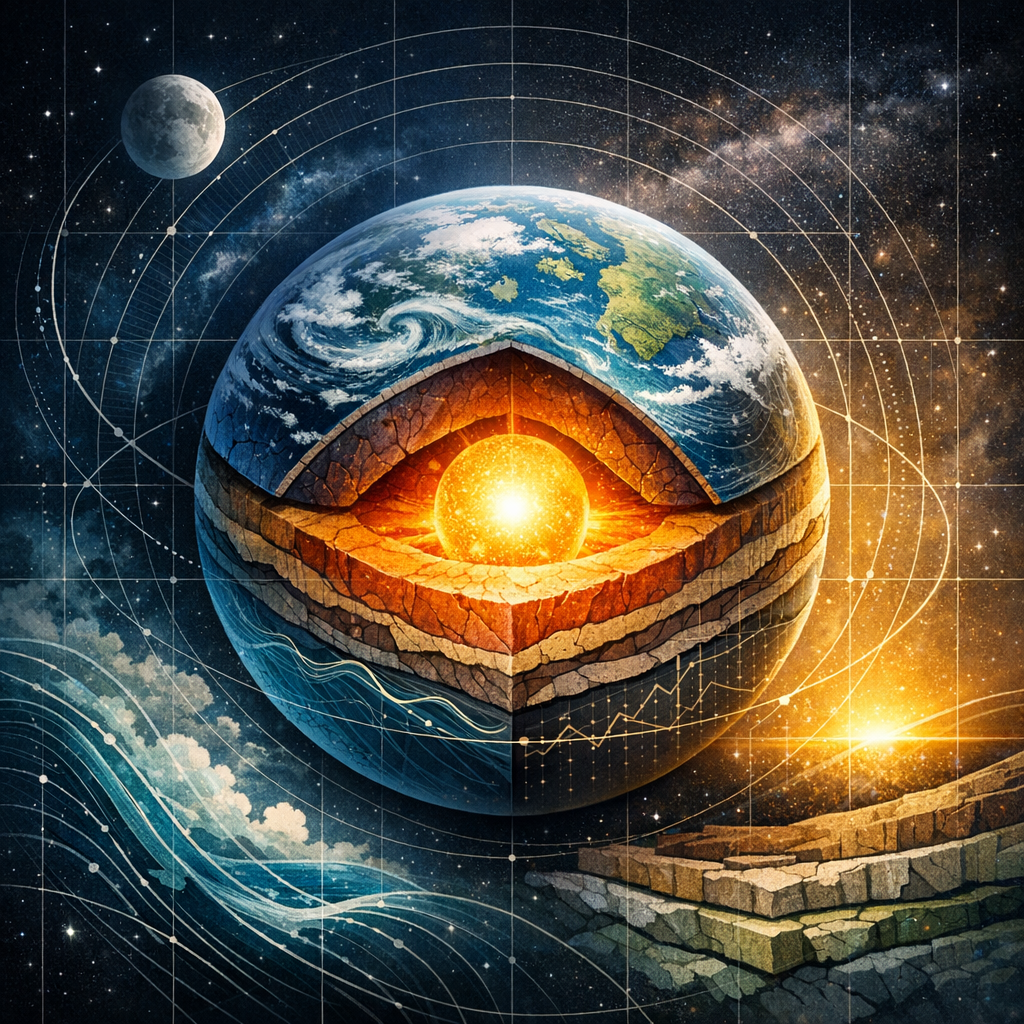
This course prepares students for the New York Regents Earth and Space Sciences exam by combining full content instruction with practical assessment practice. It is built for students who need to master tested standards, fill knowledge gaps, improve constructed responses, and become more efficient with the Earth and Space Sciences Reference Tables.
The program begins with a diagnostic so students can identify which topics and skills need the most attention. From there, lessons move through the major Regents content areas in a logical sequence: Earth materials, plate tectonics, geologic history, weathering and landscape processes, atmosphere and weather, climate, hydrosphere and oceans, Earth-Sun-Moon relationships, and astronomy. Each topic includes concrete explanations, worked examples, guided practice, independent practice, common-error review, short quizzes, cumulative review, and original Regents-style questions.
Students will learn to do the kinds of tasks the exam actually requires, including:
- read and interpret maps, graphs, diagrams, tables, weather maps, topographic maps, and cross sections
- use the Reference Tables accurately and quickly
- analyze scientific data and identify trends, patterns, and relationships
- write evidence-based scientific explanations for constructed-response questions
- solve multiple-choice questions by applying content knowledge rather than guessing
- manage time during mixed sets, timed drills, and full-length practice tests
- track repeated mistakes and use them to build a targeted remediation plan
The course is aligned to the state standards, assessment blueprint, item types, and expected performance levels for New York Regents Earth and Space Sciences. It does not focus only on test tricks. Instead, it teaches the underlying science students need in order to explain phenomena, interpret evidence, and answer unfamiliar questions correctly.
Major content areas include:
- Scientific practices and data analysis: variables, controls, graphs, models, scale, measurement, and claim-evidence-reasoning writing
- Earth systems tools: latitude and longitude, topographic maps, scale, gradient, weather maps, station models, satellite and radar data
- Geology: minerals, rocks, rock cycle, Earth’s interior, plate tectonics, earthquakes, volcanoes, weathering, erosion, deposition, soils, streams, glaciers, and coasts
- Geologic history: relative dating, cross-cutting relationships, fossils, correlation, radioactive dating, and the geologic time scale
- Atmosphere and weather: heat transfer, pressure, wind, humidity, clouds, precipitation, fronts, storms, forecasting, and regional New York weather
- Climate and ocean systems: climate controls, ocean circulation, long-term data trends, past climate evidence, greenhouse effect, and climate change
- Astronomy: seasons, moon phases, eclipses, tides, apparent motion, time zones, solar system formation, stars, H-R diagram, stellar evolution, galaxies, and the expanding universe
Practice is built into the course at every stage. Students complete diagnostics, topic quizzes, mixed review sets, timed drills, constructed-response workshops, reporting-category review, and full mock exams. Each practice sequence includes answer explanations and mistake analysis so students can see not only what the right answer is, but why their original reasoning did or did not work.
By the end of the program, students should be able to:
- demonstrate solid command of Regents Earth and Space Sciences content
- interpret scientific visuals and data with confidence
- answer both multiple-choice and constructed-response questions more accurately
- explain reasoning clearly using evidence and correct scientific vocabulary
- pace themselves effectively under timed conditions
- enter the exam with a clear plan for review, checking work, and avoiding common errors
This makes the course useful both for students aiming to pass the exam and for students trying to move into a stronger performance band through focused, standards-based preparation.