
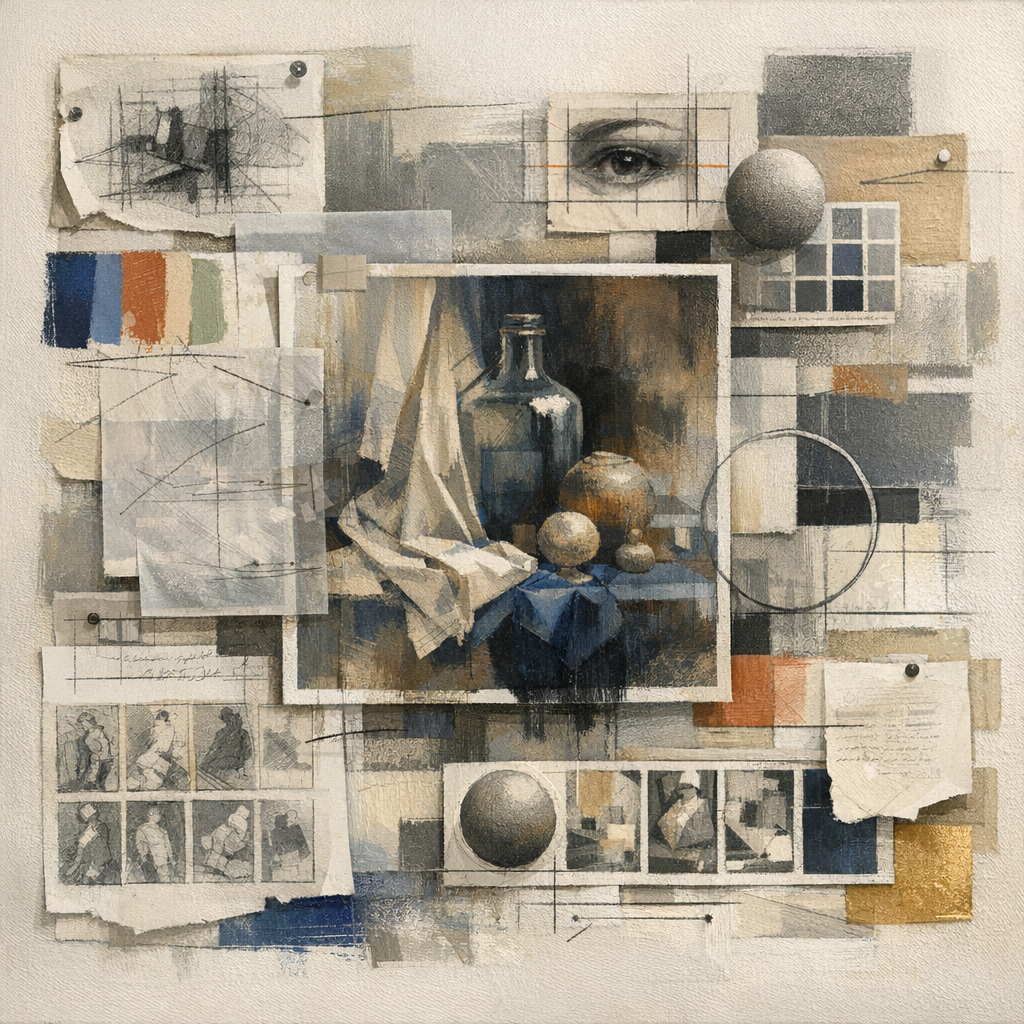
This course is designed for Year 12-13 students preparing for A-Level Art and Design, including those aiming for strong grades for university admission and those who need a deeper understanding of how high-level work is constructed, assessed, and improved. It is aligned to the selected exam board and covers the full pathway from diagnostic assessment to final outcome planning, written study, and externally set assignment preparation.
Students begin by identifying their current position through a structured baseline in observational drawing, idea development, annotation, artist analysis, and written evaluation. They then learn how the specification is organised, how assessment objectives operate in practice, how marks are awarded, and how to interpret command words, timing, and performance expectations accurately.
The programme teaches the underlying curriculum in detail rather than relying on shortcuts. Students learn how to build a viable personal investigation, select and use primary and secondary research, analyse artists and contexts, and turn research into practical development. Core visual language is taught explicitly, including formal elements, composition, scale, proportion, colour, media qualities, and subject-specific vocabulary, so students can both make stronger work and explain it clearly.
Practical development is treated as a sequence of decisions. Students learn how to record from observation, experiment meaningfully with materials and processes, compare variations, refine ideas, and build coherent development trails that lead to resolved outcomes. They also learn how to annotate work effectively, evaluate experiments with precision, and connect written reflection to assessment objectives.
The course gives substantial attention to critical and written performance. Students practise visual analysis, comparative writing, evidence-based interpretation, and the structure of the written study. They learn how to formulate strong research questions, organise evidence, integrate personal practical links, and edit analytical writing for clarity and accuracy. Timed written responses and responses to unfamiliar material are included so students can apply their knowledge under assessment conditions.
Throughout the course, students work with original exam-style questions, guided practice, independent tasks, cumulative review, timed drills, and mistake-log activities. Mark scheme training is built in so students can recognise what separates mid-band and top-band performance, self-assess more accurately, and make targeted improvements.
- Portfolio development: build stronger evidence for research, experimentation, refinement, and presentation.
- Personal investigation: choose a viable theme, structure development, and sustain a coherent enquiry.
- Artist research and visual analysis: move beyond description to precise contextual and formal analysis.
- Technical control: improve use of drawing, painting, print, photography, mixed media, and presentation decisions.
- Written study: plan, draft, and refine analytical writing with relevant evidence and personal links.
- Exam technique: interpret tasks correctly, respond to unfamiliar questions, and work effectively under time limits.
- Grade improvement: use mark schemes, feedback, and revision planning to move toward A or A* performance or a secure target grade.
By the end of the course, students will understand not only what to produce for A-Level Art and Design, but also why stronger work earns higher marks. They will finish with clearer project planning, stronger analytical writing, more purposeful experimentation, better final outcomes, and a revision strategy that is practical, specific, and tied to the demands of the exam board.