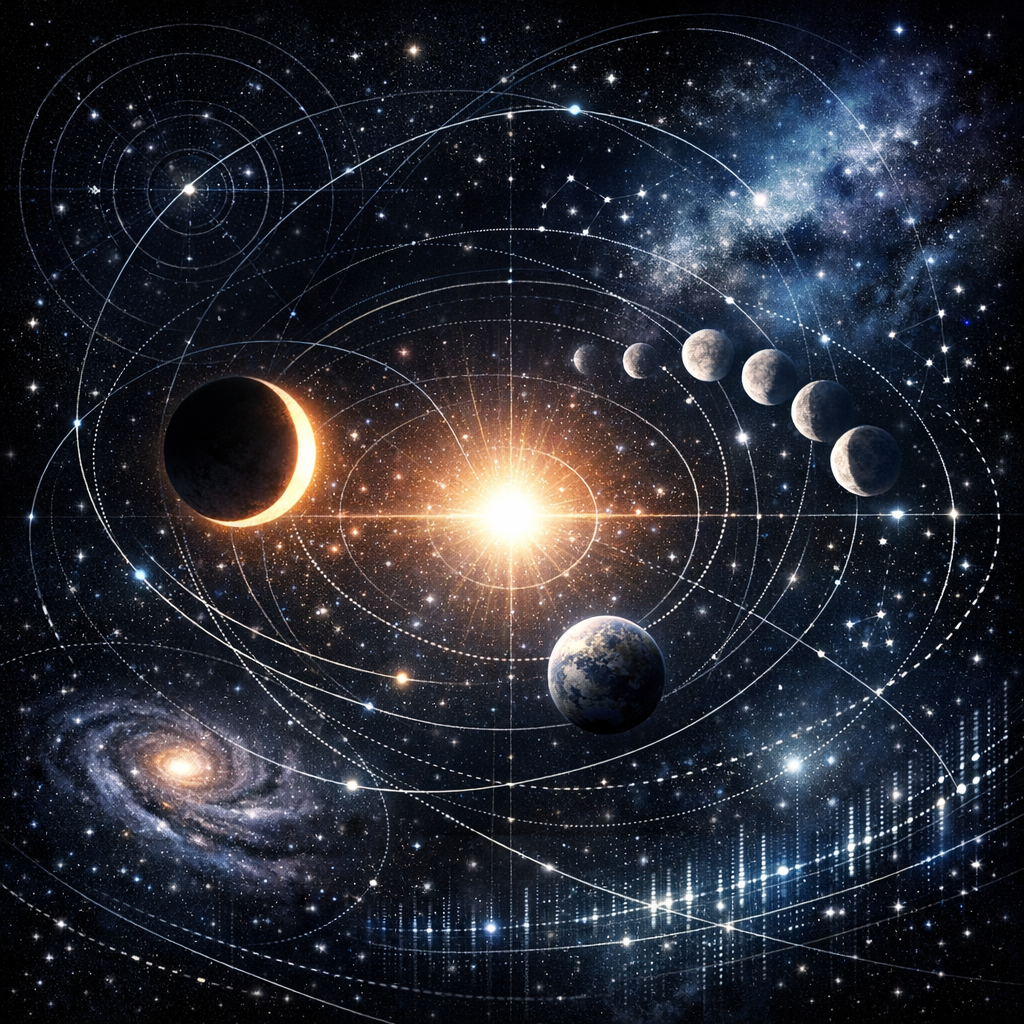
This course is a complete GCSE Astronomy preparation programme for Year 10–11 students who need clear teaching, structured revision, and confident exam performance. It is designed around the approved curriculum and the original course brief: full coverage of observational astronomy, the Earth-Moon-Sun system, planets, stars, galaxies, cosmology, calculations, diagrams, data interpretation, subject vocabulary, mark schemes, and timed practice. Students begin with a diagnostic assessment to identify gaps in knowledge and skills. They then work through the specification in a logical order, learning the science behind each topic rather than relying on shortcuts. Throughout the course, students practise how to answer exam-style questions, interpret command words, improve written explanations, and avoid common mistakes. The programme is especially useful for students who need: structured revision instead of random topic practice clear explanations of difficult ideas such as phases, seasons, tides, stellar evolution, and cosmology support with maths used in astronomy, including scale, standard form, graphs, angular measurement, and simple calculations exam confidence through worked examples, guided practice, and timed paper training practical observation support for sky charts, coordinates, lunar sketches, and observing logs By the end of the course, students will be able to: explain the core ideas across the GCSE Astronomy specification using accurate scientific vocabulary interpret diagrams, charts, spectra, tables, and observational data complete the standard calculations and unit conversions expected at this level describe and analyse the Earth-Moon-Sun system, celestial motion, telescopes, stars, galaxies, and the expanding universe apply knowledge to original exam-style questions with full answer explanations use mark schemes to understand how marks are gained and how answers can be improved complete mixed-topic revision, retrieval practice, and timed mock papers with a final grade-targeted revision plan The teaching approach is practical and cumulative. Lessons include concept teaching, worked examples, guided practice, independent practice, common error correction, short quizzes, and cumulative review. The course also builds a personal revision tracker and mistake log so students can monitor progress and focus effort where it will raise marks most efficiently. This is not just a summary course. It is a step-by-step preparation programme that helps students understand the astronomy, practise the required skills, and enter the exam knowing how to turn what they know into marks.
- Course Overview and GCSE Astronomy Roadmap
- Baseline Diagnostic Assessment
- Analysing Diagnostic Results
- Astronomy Vocabulary and Symbol Check
- Maths Readiness for Astronomy
- Building a Personal Revision Tracker
- Exam Board Specification and Required Content
- Assessment Objectives Explained
- Paper Structure, Question Types, and Timing
- Command Words and What They Require
- Grade Boundaries, Performance Standards, and Target Setting
- How Mark Schemes Reward Answers
- The Night Sky and Apparent Celestial Motion
- Constellations, Asterisms, and Seasonal Sky Changes
- Circumpolar Stars and the Pole Star
- The Celestial Sphere Model
- Angular Measurement in Astronomy
- Using Star Charts and Planispheres
- Magnitude and Brightness
- Practical Sky Observation Methods
- Earth’s Rotation and the Length of the Day
- Earth’s Orbit and the Length of the Year
- Sidereal Day and Solar Day Compared
- Time Zones and Longitude
- The International Date Line and Global Timekeeping
- The Analemma and the Changing Noon Sun
- The Moon’s Orbit and Rotation
- Phases of the Moon
- The Synodic and Sidereal Month
- Moonrise, Moonset, and Daily Motion
- Surface Features of the Moon
- Observing and Sketching the Moon
- Structure and Basic Properties of the Sun
- Sunspots, Solar Rotation, and the Solar Cycle
- The Ecliptic and the Apparent Path of the Sun
- Earth’s Axial Tilt and the Seasons
- Solstices, Equinoxes, and Day Length
- Measuring Solar Altitude and Shadow Changes
- Safe Solar Observation
- Solar Eclipses
- Lunar Eclipses
- Why Eclipses Do Not Happen Every Month
- The Cause of Tides
- Spring and Neap Tides
- Applying Gravitational Ideas to Exam Questions
- Altitude and Azimuth
- Declination and Right Ascension
- Using Coordinates to Plan Observations
- Meridian, Zenith, Horizon, and Cardinal Points
- Coordinate System Conversions in Context
- Common Errors in Sky Position Questions
- Overview of the Solar System
- Terrestrial and Gas Giant Planets
- Orbital Motion and Kepler’s Ideas at GCSE Level
- Planetary Features and Surface Conditions
- Dwarf Planets, Asteroids, and the Asteroid Belt
- Comets, Meteors, and Meteorites
- The Kuiper Belt and Oort Cloud
- Formation of the Solar System
- Identifying Planets in the Sky
- Inner and Outer Planets from Earth
- Phases of Venus and Mercury
- Retrograde Motion
- Conjunction, Opposition, and Elongation
- Recording Planet Observations
- What Stars Are and How They Produce Energy
- Luminosity, Brightness, and Distance
- Colour and Surface Temperature
- Spectra and What They Reveal
- Stellar Classification and the Hertzsprung-Russell Diagram
- Measuring Distance with Parallax
- Standard Candles at GCSE Level
- Binary Stars and Stellar Mass
- Birth of Stars in Nebulae
- Main Sequence Stars and Stability
- Red Giants and Supergiants
- Low-Mass Star End Points
- High-Mass Star End Points
- Supernovae and Element Formation
- Comparing Life Cycles of Different Mass Stars
- Reading Stellar Evolution Diagrams
- What Galaxies Are
- Types of Galaxies
- The Milky Way Galaxy
- Other Galaxies and Local Group Context
- Red Shift and Recession of Galaxies
- Hubble’s Law at GCSE Level
- Dark Matter and Missing Mass Evidence
- Interpreting Galaxy Images and Data
- The Big Bang Model
- Evidence for the Big Bang
- The Cosmic Microwave Background
- The Expansion and Evolution of the Universe
- The Future of the Universe
- Scientific Models, Evidence, and Revision of Ideas
- Why Telescopes Improve Observation
- Refracting Telescopes
- Reflecting Telescopes
- Radio Telescopes and Non-Visible Astronomy
- Detectors: Eye, Photographic Plate, CCD, and Digital Sensors
- Atmospheric Effects and Seeing Conditions
- Space Telescopes and Their Advantages
- Choosing the Right Instrument for the Task
- Reasons for Space Exploration
- Satellites and Their Uses in Astronomy
- Space Probes and Planetary Missions
- Human Spaceflight and Its Limitations
- Rockets, Launch Windows, and Orbital Basics
- Evaluating Space Exploration Evidence and Claims
- Units, Prefixes, and Standard Form
- Scale, Ratio, and Relative Size
- Speed, Distance, and Time in Astronomy Contexts
- Angular Size and Small-Angle Ideas
- Parallax Calculations
- Graph Skills for Astronomy
- Data Tables, Significant Figures, and Rounding
- Checking Calculation Answers
- Reading Solar System Diagrams
- Drawing Earth-Moon-Sun System Diagrams
- Using Ray Diagrams for Telescopes
- Interpreting Hertzsprung-Russell Diagrams
- Spectra, Light Curves, and Observation Plots
- Common Diagram Misinterpretations
- Planning an Observation Session
- Naked-Eye Observation Tasks
- Binocular and Telescope Observation Tasks
- Recording Observations Clearly
- Evaluating Reliability of Observations
- Turning Observations into Exam Evidence
- Modelling a Strong Astronomy Explanation
- Worked Calculation Examples Across Topics
- Guided Data Interpretation Questions
- Building Extended Responses
- From Weak Answer to Strong Answer
- Independent Practice with Answer Walkthroughs
- How to Decode Mark Schemes
- Recognising Level-Based and Point-Based Questions
- Using Examiner Language Precisely
- Identifying Common Lost Marks
- Self-Marking and Peer-Marking Safely
- Redrafting Answers for More Marks
- Misconceptions About Seasons, Phases, and Eclipses
- Misconceptions About Stars and Galaxies
- Calculation Mistakes and How to Prevent Them
- Exam Anxiety and Question Approach Routines
- Using a Mistake Log Effectively
- Confidence Through Retrieval and Small Wins
- Designing a Spaced Revision Plan
- Interleaving Topics for Better Recall
- Low-Stakes Quizzing for Astronomy
- Cumulative Review Sets
- Flashcards, Summary Sheets, and Retrieval Grids
- Tracking Revision Impact
- Short Timed Drills by Skill
- Section-by-Section Practice Under Time Limits
- Strategies for Multiple-Choice and Short-Answer Questions
- Strategies for Extended and Explain Questions
- Completing a Full Practice Paper
- Reviewing a Timed Paper for Maximum Gain
- Full Mock Examination and Reflection
- Question-Level Mock Analysis
- Grade-Targeted Revision Priorities
- Final Formulae, Diagrams, and Vocabulary Check
- Last-Week and Last-Day Revision Strategy
- Exam-Day Readiness and Next Steps